
gutter rainbows by Melissa Eleftherion, Querencia Press, 2024, 85 pages, $13
Reviewed by Margaret R. Sáraco
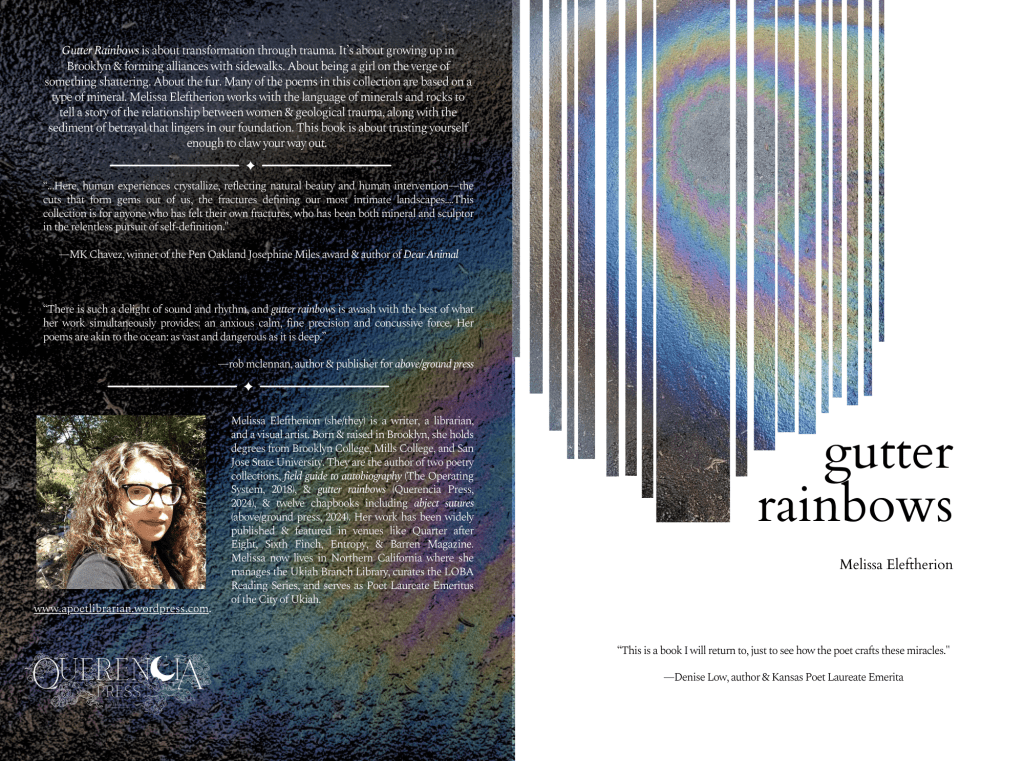
Born and raised in Brooklyn, Melissa Eleftherion, a librarian who lives in California, has written twelve chapbooks and two full length collections. Her newest release, gutter rainbows, will strike a bellowing chord with many readers. She dedicates gutter rainbows to her mom, Brooklyn friends “who saw her through,” and “to teens everywhere.” Even at the outset of the book with the first poem, “Brighton Beach,” her words will hold your heart:
sea-worn glass smoothed by ocean mouth
we wandered into your opening for
so long we forgot streetlight curfew
The author doesn’t spare emotions as she then plunges into the depths of trauma and the penultimate transformation into healing. With bravery and courage to speak out, Eleftherion opens a chest of family secrets and unleashes it for all to see.
She breaks up the collection into three sections: gasp, little ditch, and cleavage. Her startling poem in the section gasp, entitled “GUTTER FLOWER,” is reminiscent of Tommy Orange’s novel, There, There in which Orange uncovers a myriad of meaning between, inside and outside the phrase “there, there.” Eleftherion’s poem begins with an eight-year-old girl playing jacks, and flashes us through different ages—fourteen, sixteen and seventeen in abusive scenarios. She ends the poem with this stanza:
seventeen-year-old girl the aborted summer sun the
slapping a witness a hole in the door
it left a body it left a killing jar
it left its body there in the dirt lot there, there
One will marvel at the poet’s use of space on the page, word choices, as well as her beautiful and frightening images. Sometimes in dramatic contrast, her imagery is forceful, yet the poetic language is poignant.
The poet helps us unpack victim and victimization with the poem “Avuncular.” What occurs in Uncle Olly’s room erases any doubt in the reader’s mind of what is going on.
Uncle Olly pointing to me then
to the porn poster then to himself eye gleam giggles
I am 12 I am 15 I am 9
Eleftherion pushes through in the poem, explaining with poetic detail of the back and forth between the two, ending with the line “It was summertime” which may force a break in reading, a moment to absorb the suffering and the transparency in the telling.
She continues to cycle back in the collection, as demons rise to the surface. In “asnakemetrical” towards the end of gasp, she writes
Yellow calla lilies callow in the breeze
We wanted a gut of snakes
We wanted a mouth teeming with stars.
In the section, little ditch, the poet opens with “New Utrecht” in which she again uses spacing on the page to connect and disconnect with the stories behind the poems. As readers, we engage and observe.
In “Self-Esteem,” she writes, “We held hands beneath the dirt/We wanted to be trees” moving between childhood and what comes afterwards, lying sometimes in between adulthood and the pangs of growing up in a dysfunctional adult world while emphasizing the traumatic experiences of a life. We are left wondering if there was ever a childhood.
The last section of the collection, cleavage, which feels separate from gasp and little ditch, the writer has chosen poems with names of various minerals and rocks, including hematite, marcasite, Gypsum, rose quartz, amongst others, that feel like a healing portion of the journey or at the start of an understanding. The publisher’s note gives a hint to this section: “Melissa Eleftherion works with the language of minerals and rocks to tell a story of the relationships between women & geological trauma, along with the sediment of betrayal that lingers in our foundation.”
Indeed, the poet gives us a glimpse into the effort and hard work it takes to emerge from trauma. The last poem of the collection, “dichroic” she begins, is a stunning conclusion. Dichroic, according to Merriam Webster’s Dictionary is, “the property of some crystals and solutions of absorbing one of two plane-polarized components of transmitted light more strongly than the other,” and “the property of exhibiting different colors by reflected or transmitted light.” The poem transmits, reflects, and along the way, absorbs feelings, gathering all of us along the way. The poem opens with, “her story is my story is your story the axes we intersect, collide, /ruminate, devise.”Eleftherion opens a door through which you might find clues to her journey, to your journey, and answers to questions. gutter rainbows is for those of who desire to understand the power of poetry and healing and the journey we take as artists. To be present, to hold space with the poet as child and adult. Reading gutter rainbows is a profound experience, which will remain long after the book is closed.
Bio: Margaret R. Sáraco lives in Montclair, NJ. Her writing has appeared in The Paterson Literary Review, Panoply, Book of Matches, Lips, The Path: A Literary Journal, Kerning, and more. She is the author of the poetry collections Even the Dog Was Quiet and If There Is No Wind with Human Error Publishing. She has contributed poetry and reviews to Ovunque Siamo.
***
Becoming Italian: Chapter and Verse From an Italian-American Girl by Linda Dini Jenkins, Travel the Write Way, LLC, 2023, 138 pps, 17.99
Reviewed by Vincent Sergiacomi
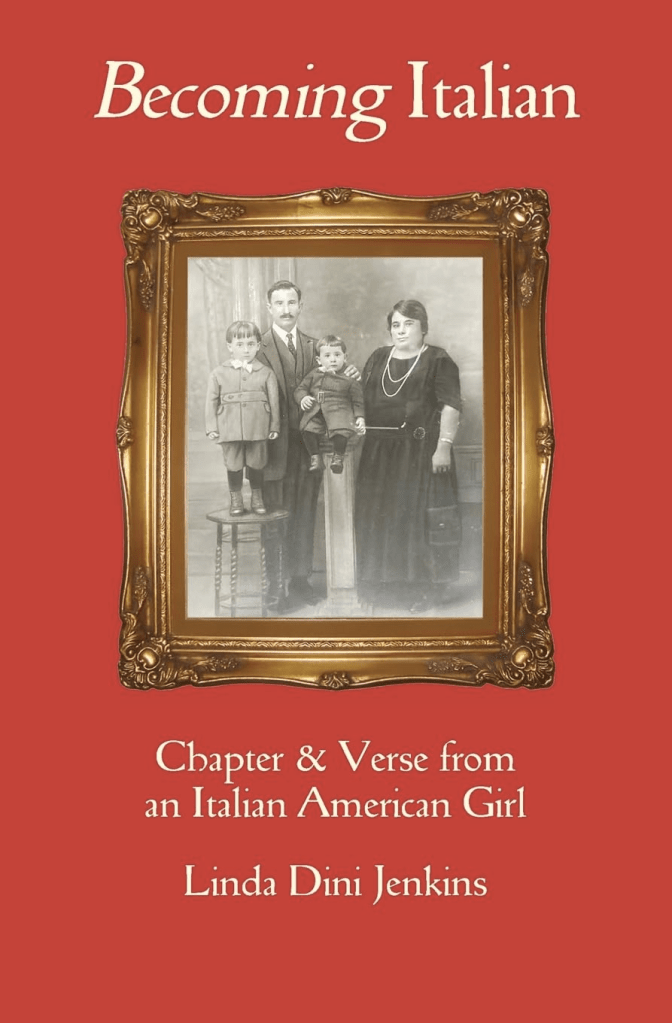
It’s fitting that Linda Dini Jenkins’ Becoming Italian is, stylistically, a little bit of everything. For a text which at its heart is about coming to terms with one’s identity, I appreciate its willingness to flit between forms and lean more heavily on its heart than any notion of structural consistency. Despite transitioning from poetry to prose and lighthearted passages to sincere ones, its transitions feel natural for the subject matter. What is the text? A little of everything – tragedy, comedy, the lessons pulled from each. And so its author is willing to incorporate a little bit of everything, and tells a stronger story for the effort.
Because of this stylistic freedom, Becoming Italian is a fascinating and engaging read. Its narrative is steeped in the interplay between ethnicity, culture and identity, which Jenkins navigates skillfully, melding elements of the three flawlessly. This begins from the opening poem, “Ancestry”, which takes a playful jab at her Englishness and its “dry, crumbly scones”. But its real character comes from what it contrasts that with – the importance and robustness of food in relation to Italian culture, and the meaning that comes with it. That contrast carries over into the next few pages, where Jenkins’ discussion of the discrimination faced by Italian-Americans in our nation’s past reminds us that no culture is just about its symbols or triumphs. It is also about its struggles, the things which lend meaning to those symbols in the first place.
The fact that Jenkins recognizes and dives into this right off the bat lends Becoming Italian a welcome sincerity. Personal struggle and cultural struggle are conflated, not arbitrarily, but because they are connected. As a young Italian American, it’s a little bit jarring at first: The most stigma I’ve ever faced for being Italian has been gentle, lighthearted ribbing from friends. Jenkins too recognizes that she didn’t face the worst of the discrimination Italian Americans have been subjected to, but the experiences she recounts are nonetheless impactful to read about: Feeling a need to fit in as a child, to not stand out too much, and – being only part-Italian – to tread that difficult line of living between cultures. Even when Jenkins is not addressing this discomfort directly, the undertone comes through, and is part of what gives this text its grace and character. Like a book you’ve read years ago but forgotten the details of, the experience is part of you, but gets lost under the surface; the feeling comes through stronger than any recognizable detail.
I find myself drawn to the parallels between Jenkins’ text and the evolution of what it means to be an Italian-American more generally. After all, the relative ease of my existence compared to that of my ancestors is a result of our ability to assimilate into the dominant culture – more cynically put, to become less Italian, more American. That trend is no coincidence; it’s the same fact, I’m sure, which led Jenkins’ father to join the U.S. Navy in the Second World War, to dress his daughter in the dominant style, and which, in this text, represents the culmination of the author’s own struggles to truly embrace her Italian heritage while also establishing her own identity distinct from that heritage and her own family’s past. As she elegantly puts it:
You see, in some ways, I simply had to choose. I had to create a new life for myself. Choose what kind of person I would become. Choose where my future would lie. […] Day by day, I am learning more about who I am and how I want to live in the world. And I am so grateful to everyone who has watched me take this journey and has cheered me on.
Culture is perpetuated by individuals, and Becoming Italian is a wonderful representation of how its author has forged her unique identity in the context of her culture. It is an intimate, sometimes confessional text, and the relationship between its author and her heritage provides a fascinating backdrop to understanding the story of culture and individual simultaneously. Few texts manage to achieve something so elegant so effortlessly; I enjoy Jenkins’ profound musings as much as her conversational poetry. This is a text which is overflowing with meaning and personality, and I cannot recommend it enough.
Vincent Sergiacomi is a writer living and working in Philadelphia.
***
Pasquinades: Essays from Rome’s Famous Talking Statue by Anthony Di Renzo, Cayuga Lake Books, 2023, 263 pp, $20
Reviewed by Christina Marrocco
Despite the complex nature of this collection, it is never confusing or elitist. In fact, the contrary is true. The essays are delicious and digestible. A delight. It’s one of those books you will find yourself chomping at the bit to get back to. If you can put it down at all. It’s also one of those books that as you near the end you will feel a measure of melancholy that it’s going to end. However, I promise, as Rome is layered and archaeological, so are these essays, and you return again, finding new treasures under the old, rejoining your friend Pasquino, re-entering Di Renzo’s book and thereby Rome. Continuing to find meaning and beautiful relics that speak to this humanity. The blend of pure creativity and historical knowledge required to make this book come alive is nothing less than stunning and like nothing else you’ve read. .
The timing of the release of Anthony Di Renzo’s latest book, Pasquinades: Essays from Rome’s Famous Talking Statue couldn’t be better in general or for me personally. Social media has pushed to the forefront this idea or realization that a great many men think about the Roman Empire most days. And I’d argue that many women do as well. At least women who love Rome. Personally, I’d just come away from reading another lovely book set in Roma and binging a Netflix drama set there as well. Rome may be on our minds more than ever in myriad ways. But maybe most importantly, in these times of upheaval, of war, of confusion, the eternal city offers much in the way of a strange blend of stoicism, cynicism, and common sense. And in these essays, the narrator, Pasquino provides that and much more. He meets us near the fountain, on the stones, under the eves, to guide us through history, but not just history, to guide us through that eternal city and via it, the eternal experience of what we have been, what we are, what we are becoming. Romans, especially, all of us tangentially.
Di Renzo is simply a beautiful writer, and I’d had the pleasure of reviewing his outstanding book of dual essays, Dead Reckoning, written with Andrei Guruianu some years back. If you haven’t read that book yet, you should get it when you order Pasquinades. And yes, please, get your hands on Pasquinades. What Di Renzo achieves here is the very best of literary essay folded into a conceit that dances with magical realism. Here’s that conceit: Pasquino is the city’s savvy and witty talking statue–pulled directly from history himself–representing the voice of the people. He, in a series of deliciously detailed outbursts and insights, guides readers through Rome. Di Renzo himself is secretary to Pasquino, a literary midwife of sorts, and brings Pasquino’s essays of observation to the page. While the conceit is delightful, readers will soon realize it’s the fascinating aspects of the content of Pasquino’s essays that truly capture them. Suspension of disbelief sets in within the first page or so. It’s transportative.
Pasquino the statue speaks from a depth of experience that borders on immortal within the eternal city–borders on because he is missing some of his parts and was made and could be ground to dust. But in comparison to the narrator, we are flashes of light in time, and so with is longer gaze, he is able to bring the layers of Rome, the layers of humanity in toto, to us at a very different speed than that by which we live our short lives.
We are also in the contemporary age as much as the ancient–and all the span between–as if time is elliptical or at least layered and blending as in this section where Pasquino gives us insight into the way a story lives on and also is not heeded. The connecting threads: the ornate, ring wearing fourteenth century dictator Cola Rienzi and Mussolini:
“The plebs butchered him. Cola’s mangled body was dragged by the foot to Piazza San Marcello, and strung upside down from a balcony. For two days, it hung there, its guts dangling, like the carcass of an ox. Urchins threw stones and jeered: ‘Now make a speech!’ Over the centuries, Cola’s life has inspired poets, painters, and composers, but his death, I regret to say, has never impressed other dictators. Aldo Parini vainly warned Benito Mussolini on the eve of World War II. ‘This regime of yours will end badly’ said Parini, an old Socialist who had been Il Duce’s friend in their youth. ‘Such things always do. Benito, you’ll die like Cola Rienzi.” Mussolini grimaced in mock horror then laughed and spread his fingers for Parini’s inspection. You see” he said. ‘ I wear no rings. It will never happen to me.’”
The essays are delivered, studded with gems like the above, not chronologically but in a much more interesting manner. As Pasquino connects one process to the next. Reminiscent of French New Wave film editing–and it suits the collection very well. Seamless. Add to this the voice of Pasquino, warm, somehow both calm and passionate, thoughtful, humane, and still curious after all these years. It is the voice of a friend you have been waiting to meet all your life, this statue who will share history and human foibles to you with something akin to patience but much more exciting than that. And then there’s the “savage aim” of Pasquino’s commentary–witty, multitudinous, able to hold the polyhedron of intelligibility in his marble mind and put it forth to us readers so smoothly and intelligibly.
Despite the complex nature of this collection, it is never confusing or elitist. In fact, the contrary is true. The essays are delicious and digestible. A delight. It’s one of those books you will find yourself chomping at the bit to get back to. If you can put it down at all. It’s also one of those books that as you near the end you will feel a measure of melancholy that it’s going to end. However, I promise, as Rome is layered and archaeological, so are these essays, and you return again, finding new treasures under the old, rejoining your friend Pasquino, re-entering Di Renzo’s book and thereby Rome. Continuing to find meaning and beautiful relics that speak to this humanity. The blend of pure creativity and historical knowledge required to make this book come alive is nothing less than stunning and like nothing else you’ve read.
Christina Marrocco is a writer living in the suburbs of Chicago. She is the author of Addio, Love Monster.
 OVUNQUE SIAMO