

No Pictures in My Grave: A Spiritual Journey in Sicily by Susan Caperna Lloyd (Ovunque Siamo Press, 2024)
Reviewed by Barbara Corrado Pope
Roots. We all search for them. But what if we don’t make the connections we hope for? And what if we want to cut ourselves off from certain aspects of the past? In the first few pages of the commemorative edition of Susan Caperna Lloyd’s engrossing No Pictures in My Grave, we come face to face with these contradictory desires.
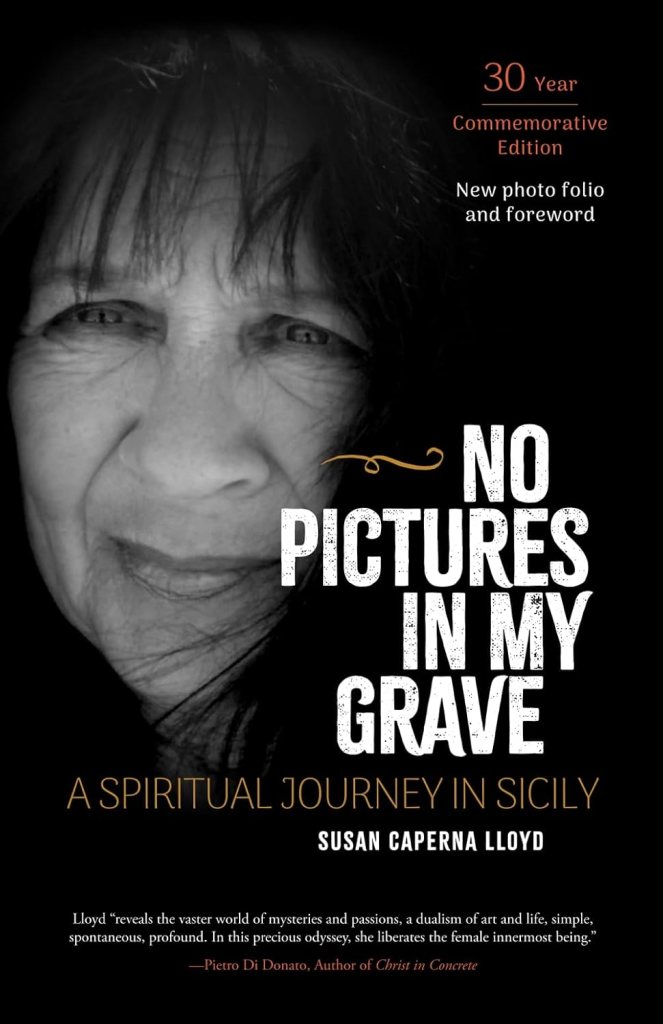
In the new Forward by Elisabetta Marino of the University of Rome, we discover the source of the enigmatic title: Caperna Lloyd’s love and admiration of her grandmother Carolina, and her rejection of the selfless and dutiful role Carolina played throughout her life—a role that the men in the family expected to extend beyond the grave. Young Susan watched as they placed their pictures in her grandmother’s grave expecting that she would continue to care for and protect them. This did not discourage Caperna Lloyd from making the journey to her ancestral home in Italy, only to find her blood relatives were “distant and indifferent.”
She searched elsewhere for roots and family and hoped to find them in Trapani, Sicily and the famous Holy Week Processione dei Misteri. The Processione became the catalyst for Caperna Lloyd’s two-pronged spiritual journey and, eventually, the subject of her beautiful documentary film of the same name.
The procession is made up of 20 ceti or statue-groups, weighing up to 800 kilos, carried for 24 hours by groups of portatori, who often return from far away to take part. Most of the statues depict the familiar Stations of the Cross. But the first and the last tell the Mother story that Caperna Lloyd discovered was most important to the Trapanesi. The first depicts Jesus’s departure from His mother and His young disciple John and the last is the famous Madonna dell’Addolorata standing alone in her sorrow. The story becomes, then, the grieving Mother searching for her Son. The procession cannot come to an end until she enters slowly and ceremoniously into the Church of the Purgatory where all the other statues now reside.
Tracing the history of the Procession to the early modern period of Spanish domination, Susan began her world-wide quest to document the continuing and varied existence of this tradition in world-wide Hispanidad, lands once conquered by Spain. Her brilliant photographs of these rituals are now in the American Folk Life Center at the Library of Congress. Her account of a female crucifixion of Lucy Reyes in the Philippines is the basis of another book.
The second quest, recounted in No Pictures in My Grave, was more personal. Observing that the Procession itself was a very masculine affair (women only walked as mourners at the end of the Procession), Caperna Lloyd set out to discover why the Mother was so central to the story. After a survey of Greek and Roman myth she focused on the story of Demeter, who had once been worshipped in Sicily, and her daughter, Persephone. Demeter, too, mourned and searched for her child after she was kidnapped by Hades. This story ends with the creation of the seasons, as Demeter, the goddess of agriculture, left the land barren until Persephone was released every spring.
Part of Caperna Lloyd’s own story is her quest to find the physical traces of Demeter worship in Sicily and the nearby islands, something her Sicilian acquaintances met with indifference, even as they had perpetuated the meaning of the myth in their own Catholic worship. This spiritual journey often entailed the very non-spiritual reality of what it meant to be a woman traveling alone in a culture marked by male dominance.
Her account brilliantly weaves together the historical, the mythical, and the personal.
Again and again she returns to Trapani for the Procession, and to decide if it is possible to become part of its family. She does. But only on her own terms
Saint of by Lisa Marie Basile . White Stag Publishing, 2025. 78 pages, 18.99
Reviewed by Nicole Monaghan
Saint Of’s poems brim with a desire to be found, to belong, to be. Burning with a primal ache for love, one feels the quest for origin in piece after piece. Throughout the collection, that universal elusive question prevails, who am I? It reads like a prayer, a haunting, but also a spell. Saint Of’s narrator seems to beckon that something, anything validates her very existence:
Let me stay my mother’s daughter–
abject, violenced, shaped of longing.
This is the wound I can accommodate,
& know so well.
(Saint of Orphaned Girls)
But even without ever having known something, the human heart can imagine it. Each poem dares God, or fate, or the universe to bring a return to somewhere home-shaped
(Saint of the Before Times). In spite of profound pain, a holy hope lives in the imaginings.
With a cracked open heart, we feel the meticulous tending of abandonment wounds. Succinctly wrought and with the usual associations turned on their heads, summer does not equal solace but rather suffering. In Basiles’ hands, lush gardens of July are rendered as purgatory. Acting as an uncrossable chasm between having been orphaned and having been born, rather than soothe, summer consumes and infiltrates. Each poem is an attempt to return back to spring, a love letter to a lost mother. The longing stretches over subsequent summer after summer. Every heart that has experienced loss or grief will recognize these stunning rose gardens.
No Known Coordinates, Maria Terrone, The Word Works, 2025.
Reviewed by Jennifer Martelli

In her poem, “Reversals,” Maria Terrone writes,

                We left
    the negatives hanging from their hooks,

    we left the shock of our own frightful faces,
        but just for a little while—like snow

    before it slides away, revealing
        first a tree and then the tree’s true color.
The poems in Terrone’s latest collection, No Known Coordinates, explore the concept of gazing, of capturing the image, as only an artist can. Terrone presents a life, and all of its traumas, that slowly come into focus. The emotional cost of this gazing emerges through the collection’s meticulous structure, its artistic sensibility of shading and emotions on the poetic line, and finally, the speaker’s acceptance of what remains after erasure, after boundaries are blurred.
In “The Birthday Gift,” Terrone writes, “. . . the image never stopped developing for me.” The book’s five sections function as a darkroom, as a camera’s lens as it turns, trying to capture just the right amount of light and dark, always reaching for depth and clarity. The first section is a study of contrasts, much like a black and white photograph. “Under the El” gives movement to these contrasts, a “flux we’re born into,” “a shadow-tarnished toy, light & dark / poured out in equal measure.” Terrone adds color in the second section, as well as danger. In “The Gun,” the intrusion of color is shocking: “A child has left a yellow plastic gun / in our gardens . . . No lemon shines as bright as this barrel.” Depth and texture are added to the book in the third section with its images of “the fall with a camera’s freeze action—” Subway rides to other parts of the city bring the speaker below the surface, “after hours underground, it was blinding—” The fall in this section prepares the reader for the trauma which nearly “erases” the speaker in section four: a childhood concussion and a sexual assault, which is a blurring of boundaries, a disappearing of the girl. Throughout this section, we read of “a bottomless sorrow,” as well as a disappearing child, “Gone the wings, gone the girl.” In “Erased,” the actual structure of the poem is disjointed, split, vulnerable, and opened to all the white space on the page:
He was lurching,
reached out,
grabbed hard between my legs.
I shook.
Alone on that street.
Rooted in concrete.
Not able to speak.
Not.
Not I.
Just not.
No, that didn’t happen.
Not to me.
The final section brings the picture into a vaster view. In “Message to Google Earth,” Terrone homes in on the concept of being gazed at:
but focus back on me.
Now stop.
Enlarge the image to a woman laying on her back
in that last waiting room:
land of no known coordinates.
There’s a resolve in this section—or a hope. Terrone writes in “Of Tattoos and Medieval Messages,” “I will try, I will try to love and live without fear.”
“When I dive into reflections, I feel most alive,” the speaker tells us in “Rain.” Terrone’s poetic technique is palpable, exciting. Terrone’s balancing of hues and emotions create poems that are vibratory, and perhaps dangerous. Throughout this collection, these contrasts are in close proximity to each other: “Black bark becomes white in snow,” “peering/into darkness in daylight,” “once too large for me and then too small,” “a story I’d never read, but somehow knew.” In the poem, “Under the Hawthorn,” Terrone imbues the tree with these contrasts:
Tree that leans away from its weight
of its contradictions, at home
with my restless presence and dissonance
of the cognitive kind:
    I hold this truth/untruth to be
    self-evident/hidden

    A centenarian, modern tree
    steeped in conflicting mythologies
    daring me to touch a leaf.
Terrone maintains a “nameless and numinous” tension when she asks, “Where is that black-and-white photo of myself. . .” Throughout this collection, the speaker contemplates if the erasure of memory eliminates the girl. “I wore its charcoal smudge like Ash Wednesday,” Terrone writes in “A Girl in Winter,”
    but not on my forehead—within,
    and I was charged by that, the knowledge
    a mark that would not wash off.”
No Known Coordinates, “self-possessed as ghosts and art can be,” presents itself as “an argument / against the void—” deliciously chafing against “the long, slow erasure.” This poet, like an expert photographer, opens and closes the lens for the reader and creates
a darkroom distorted
by distance & memory, us standing close
together in its hush, waiting to see
what develops—
Maria Terrone has written a collection that I experienced as both poetry and spirit photography, a collection that insists on kindness, “believing / that a shift will come, a star, a kiss.”
UFO Symphonic: Journeys into Sound by Mike Fiorito. Apprentice House, 2025. $21, 350 pages.
Reviewed by Vincent Sergiacomi
“What we perceive as something that has evolved from our sightings of unidentified flying objects, something from ‘out there’ is really about us and our relationship with the ‘out there’.”
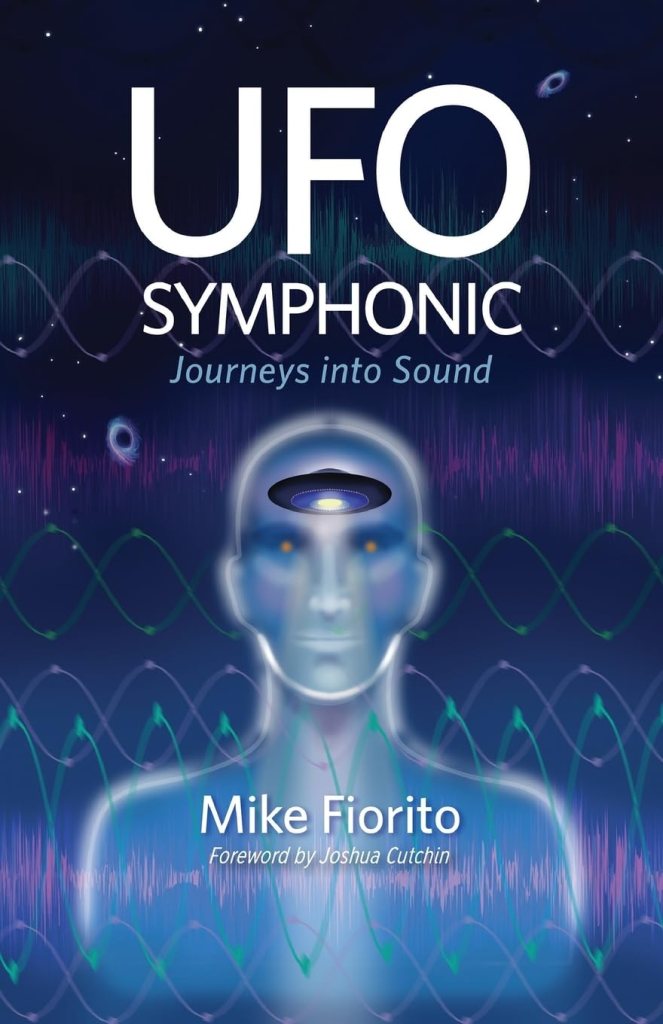
Mike Fiorito has done it again. For those familiar with Fiorito’s previous novel (For All We Know), UFO Symphonic feels like a natural and worthwhile progression. Fiorito’s deft navigation of emotionally complex discussions is still front and center, and for as much as I loved For All We Know, I think the premise of UFO Symphonic is actually more amenable to its author’s natural way of writing.
As he juts between citing scholars and mystics in the opening sections to relaying his own and others’ stories as we progress, it’s clear that this is the voice of a teacher. Fiorito’s passion for “The Phenomena” (as he calls it) is unabating throughout. His prose is rapturous, and his respect for both the subject matter and the sanctity of his interviewees’ stories is obvious. This is just conjecture, but the impression I got was that this is the kind of book Fiorito has been meaning to write for a long time. The structure, the setup, and the execution – they all feel rehearsed in the best way, intentional and complimentary.
At its heart, UFO Symphonic, as the opening quote of this review suggests, is about human relationships. More than that, it is about the relationships we form with the world around us, often in ways we don’t recognize or fully understand. Fiorito’s object of focus in this text is music, and to an extent, sound more generally. As he explains, music “evokes all emotions” in a way which is universal, transcending other forms of communication. This is the premise for using music as a tool to broaden our understanding of other transcendental things.
Fiorito establishes this foundation early on. The opening chapter is a scholarly yet also deeply personal whirlwind which reminds me a bit of how Peter Matthiessen teaches us of Buddhism in his seminal The Snow Leopard. The lesson is not removable from the experience, so both are given together.
In this way, the text feels almost dreamlike. We see the lessons our author highlights come to fruition in his conversations with others. Their stories have the same ephemeral quality as his retellings of his own life: Everyone is hinting at something greater, something not fully comprehensible. Yet the implication, and this awareness of the presence of an “Other” feeling, is constant. Fiorito is a skilled storyteller, and I think the biggest part of that is his ability to imbue that unspoken quality everywhere in this text.
Whether or not you are interested in the sort of supernatural phenomena Fiorito is so deeply enamored with, the real gift of UFO Symphonic is in the beauty of its writing and depth of its storytelling. I’ll admit I’m skeptical of these phenomena myself, but it’s nevertheless fascinating and important to hear such deeply personal accounts of a side of the world many of us rarely think of. As an exercise in thought and a meditation on the ways such different parts of our world can overlap and converge, UFO Symphonic is wonderful and unique. Fiorito is equal parts journalist, philosopher, and raconteur here, and I wholly recommend you pick this one up.
 OVUNQUE SIAMO