

Even the Dog Was Quiet by Margaret Saraco, 2023, 96 pages, $15
Reviewed by Vincent Sergiacomo
“The world has changed or has not changed at all.
Really, we are here for a moment and then we are gone.”
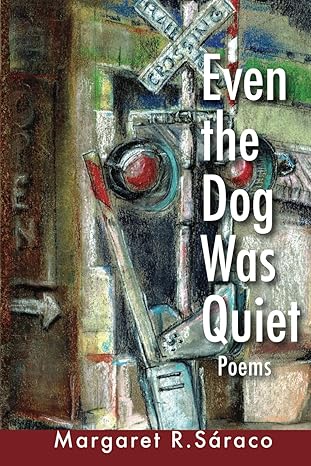
Margaret Sáraco’s Even the Dog Was Quiet is as consistently devastating as it is constantly beautiful. A deeply personal collection which fluidly melds detail and emotion, Sáraco’s storytelling mastery is on display throughout. Every poem here is about people – from the close friend killed by AIDS before he reaches thirty to the cab driver who tells you one story and disappears forever – and all of these people feel vibrant and important. Stories flit back and forth across time, and the whole thing feels like an act of remembrance.
Part of this feeling comes from Sáraco’s consistency in setting the collection’s tone. She opens with brutal irony from its first lines – in opening piece “Swoosh”, her speaker invites us to “look at me fly” as she finds her footing. Seconds later, “Undocumented Roots” hits us with a dose of reality: “The night my grandparents’ house caught fire”, she tells us, “everything burned.” Each poem is a memory presented out of any obvious order, yet taken in unison, they supplement each other. These manifold snippets of time combine to create an identity, vivid flashbacks of a life, and together become a whole which is greater than the sum of its parts.
Even the Dog Was Quiet, then, is a collection which is just as much about each moment as it is about the aftermath of those moments, and their impact on the speaker who shares them with us. The text actively “builds” its focus over time: We begin with the foundation, these disparate memories, and eventually see the threads which connect them. “Pink Hula Hoop,” in which the poem’s speaker laments that she “had to write this poem to remember everything”, comes right after a piece on the death of the speaker’s mother. Taken together, this act of remembrance has greater weight to it. We are not simply remembering the moment; we are trying to keep it out of death’s hands, keep it with us forever.
That preoccupation with mortality is not accidental, nor is it fleeting. Death is everywhere in Even the Dog Was Quiet. Sometimes it is faced head-on: In “Devozione”, the dog will not accept its master’s demise, even as the speaker and her kin are forced to. Sometimes it is in the background: “After Parkland” fixates on looming fear, uncertainty, and powerlessness. And sometimes it appears uninvited, almost like it shouldn’t be there, as in “Pianissimo”, where moving a piano becomes an exercise in wondering whether we’ll die today. Over the course of the collection, this becomes our speaker’s torment: Not only is death inescapable, but preoccupation with death while she should be living becomes equally insurmountable.
There’s a subtle, fascinating sort of motion to this text. We are remembering – this collection is about remembering – because it is the only thing we can do. Death itself is not the central focus, even as it comes up time and time again. The focus is the instinct to escape it, the anguish when it rears its head regardless, and the turmoil which comes when we think too much about it. And finally, when it becomes evident that the battle against it is lost – because of course that is a battle which none of us can win – the speaker’s acceptance is still tempered, still hesitant, still noncommittal. Even the Dog Was Quiet is a series of poems about learning to live alongside death, and it is about all the other things that die when we do. It is about the shared experiences, the moments of connection, the memories we share with one or two others. When both of us leave, the text seems to beckon, all of these things leave too. Perhaps Sáraco’s greatest achievement, then, is that I remember the stories she tells me. I remember how the old man would bring bluefish to the house, and how mother would cook it even when no one would eat it. I remember our speaker sitting with her coworker in the darkroom, half-flirting, half-just enjoying herself. I remember Bobby and his bonfire, the most fleeting of teenage loves, yet still impactful enough to keep in mind decades after the fact. And in Sáraco’s vibrant, powerful vignettes, I recognize portions of my own life – the memories, the twinges of loss and regret, the fear and looming uncertainty. The instinct Sáraco writes to is universal: to love, to be loved, and to remember. Thought-provoking and wonderfully presented, Even the Dog Was Quiet is beautiful and deeply important. Give it a read; I guarantee it will be well worth your time.
Vincent Sergiacomi is a poet and writer. His poetry has appeared in publications including Poetry Pacific, the Eunoia Review, and the Moonstone Arts Center’s New Voices anthology. His criticism has been featured in Ovunque Siamo and the Philly-based Loco Magazine. Vincent holds a degree in English from Arcadia University, and currently resides with his partner and their cat in Northwest Philadelphia.
Fassbinder: His Movies, My Poems by Drew Pisarra, Anxiety Press, 2024, 97 Pages, $15
Reviewed by Margaret R. Sáraco
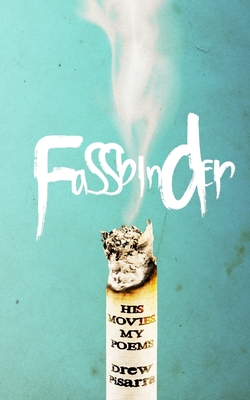
Drew Pisarra’s latest collection, Fassbinder: His Movies, My Poems, is inspired by the New German Cinema filmmaker, actor and dramatist, Rainer Werner Fassbinder (1945-1982). The films plunged into the depths of oppression and fear, exposed our souls, complications of addiction, cultural obsessions and were at the forefront of queer-themed cinema during his brief life. He died at 37, from a drug overdose. Facing controversies and scandals, he created brilliant emotional films. In the late 1970s and early 1980s, when these movies opened in New York City, they were a phenom.
Both filmmaker and poet explore different artistic expressions while embarking on subjects that are real and uncomfortable. Fassbinder made over 40 movies, 2 television series and 24 stage plays. Pisarra writes for theater and radio, is a poet (Periodic Boyfriends and Infinity Standing Up) and short story writer (Publick Spanking and You’re Pretty Gay). This book is an in-depth literary conversation between poet and movie director.
Pisarra began his movie watching/writing poem obsession after seeing The Marriage of Maria Braun a decade prior to publishing this book. He saw another film, wrote a poem, repeated the process as he journeyed through Fassbinder’s filmography. The poet organizes the book by the film release dates from 1965 to 1982, with two unfinished pieces films, Rosa L. and Kokain completing the collection. Titles of the poems are the names of Fassbinder’s films except for the first poem, “Dear Rainer,” a combination fan letter and homage.
The book includes the well-known film, “Veronika Voss,” about a celebrity actress during the Nazi Regime and her fall from grace. Pisarra asks a series of questions in his poem, then in the last stanza answers them in a rat-a-tat-tat fashion.
The poem, “Pre Paradise Sorry Now,” playful but with a dark edge, begins with “Knock, Knock” jokes, then the poem turns halfway through, much as the filmmaker did in his movies:
Knock. Knock.
One gets tired of the same old answers.
Knock. Knock.
One gets tired of the same old knocks.
The joke loses meaning as Pisarra deftly rewrites the familiar bedtime prayer:
Now I lay me down to sleep
I pray the Lord my soul to keep
If I should die before I wake
I pray the Lord my soul to take.
Scratch that.
Now I lay me down to sleep
I’m counting snakes instead of sheep
If I should wake before I die
The devil is my alibi.
Pisarra writes in various poetic styles, showcasing his versatility. “Das Kaffeehaus: Director’s Cut” resembles film script pages complete with characters, setting and action, opening and closing with the narrator’s reflection. “The Coffee House” poem follows where each line begins with “Some things” in four quatrains, using an ABAB pattern and reads like an adult themed nursery rhyme inching its way beneath the skin.
Some things cannot be forgiven.
Some things are not what they seem.
Some things are reasons for living.
Some things fall short of the dream.
Besides writing narrative/prose and rhyming poetry, Pisarra plays with structure. “Love is Colder than Death,” is a recipe. The ingredients include “2 petty criminals, shaved” “4 white corpses (male)” and “1 white corpse (female)”. The poem also includes “Directions:/Shoplift ingredients.” Even when writing of dire topics, Pisarra adds a dash of humor, a space where poet and filmmaker diverge.
“A Little Chaos” weighs in on time’s fleeting nature and relationships.
It takes one second to break a plate,
ten seconds to say the wrong thing,
two minutes to dig yourself into a hole,
and a full night to overstay your welcome.
“The Bitter Tears of Petra von Kant,” begins with
If sadness you must wear,
drape it like a Halston.
Let sorrow hang like a sheath
without so much as a bra
for support. Sag.
The poet ends with the line, “You can’t breathe//Why should your clothes?” Pisarra writes about breathing and breath several times, perhaps in juxtaposition to dying and death and touches on suicide, guns and violence as poetic response to these films.
You need not be familiar with Fassbinder’s work before reading this collection, but it adds a layer of understanding. In some parallel universe, perhaps filmmaker and poet could meet and exchange ideas, share inspiration and creative energy. Fassbinder: His Movies, My Poems leaves us questioning humanity and our motivations for survival through a camera lens and inside the pages of a poetry book.
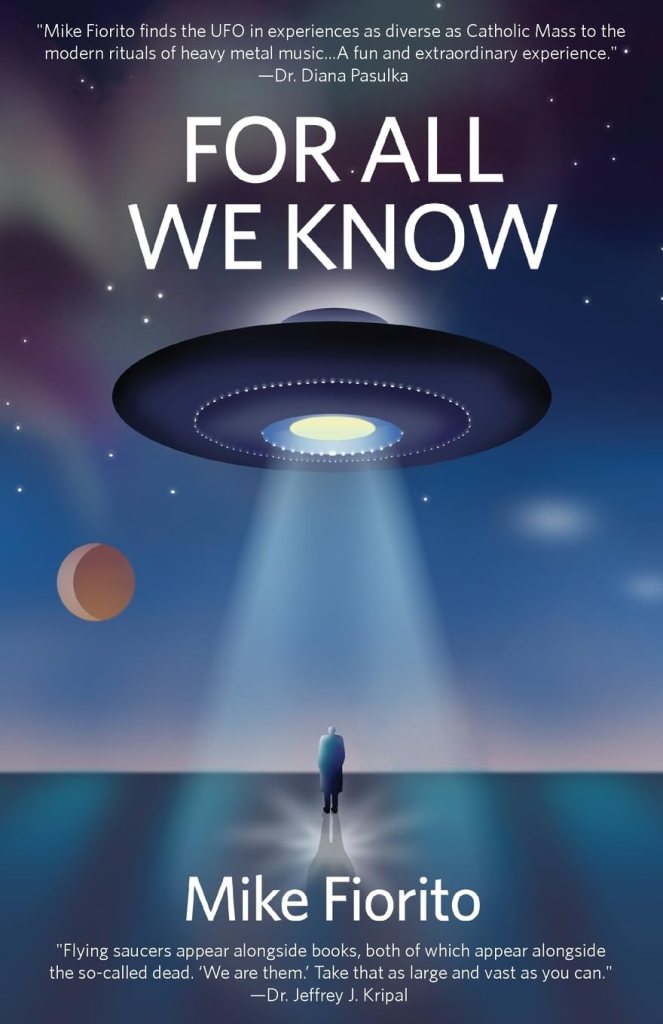
For All We Know: A UFO Manifest by Mike Fiorito Apprentice House, 2024, 146 pages, $16 pbk
Reviewed by Vincent Sergiocomo
When I first read Joseph Heller’s seminal Catch-22 , I got a distinct sensation a few pages in. For the uninitiated. Catch-22 is known for many things, but the sensation I’m referring to is about that book’s flawless execution of its dry, absurd humor. After about four pages of reading, you realize that the humor and the plot are perfectly in sync. Jokes aren’t being forced – rather, the humor arises from its author’s grasp on the situation, and his recognition of how to make it funny. Essentially, the author knows what he’s doing, and it’s magnificent.
I mention this because, to date, there are two books I’ve read which have elicited this feeling. Catch-22 was the first; the second was Mike Fiorito’s surprising and spectacular For All We Know.
For All We Know is at once chaotic yet tightly focused. The plot follows Matteo, an Italian youth from a housing project in Queens, to his education at NYU, then a move across the country, and finally back to the East Coast, by which time the plucky boy has become a quirky middle-aged man. That would be pretty standard fare by most accounts, but Fiorito makes it exciting by tracing Matteo’s emotional and psychological journey in just as much (if not more) depth. And as you might be able to tell from looking at the cover, the metaphorical underpinning of Matteo’s development as a character is fueled in large part by his fascination with UFOs, which is where this book’s unique and charming brand of chaos comes into full swing.
In Fiorito’s hands, though, UFOs are not just flying saucers. “UFO” becomes a stand-in for the various sorts of metaphysical exploration which Fiorito’s protagonist so loves to imbibe in. Matteo is a restless and curious character, which is perfect, as he becomes a suitable vessel through which Fiorito’s deadpan philosophizing gains a voice. Chapter titles hint at this – “Church as a UFO” sees a teenaged Matteo understand his Catholicism in a new light after smoking a joint before Mass, while “Books as UFOs” details middle-aged Matteo’s descent into almost-madness, fueled by an obsessive desire to quite literally read until he drops.
In Matteo, we see the shifting tides of a lifespan spun out and boiled down into clever, hilarious, and sometimes devastating anecdotes, at once beyond belief yet entirely plausible. In “An Ebbing Red Sea,” a young Matteo and his sort-of-friend Ivan take LSD, at which point Ivan procures a knife and grins at Matteo “like a deranged Cheshire cat.” Matteo’s response is to present his finger to the knife-wielder, “to challenge him” as Matteo describes it. Perfectly plausible, if you’re young and have nothing to lose, or – as is perhaps indicated by Matteo’s subsequent surprise when Ivan actually stabs him – if you cannot comprehend what you have to lose.
Fast forward a few chapters to “Living for Free”, at which point Matteo has graduated college and found freedom out west. Freedom, it turns out, which is dampened by his father’s chronic illness. “Pancreatic cancer,” his brother tells him on the phone. “He has three months to live.” So Matteo comes home, and though the boy has long since become a man, his father’s last words to him call out to the boy:
When [my father] gets to me, he says “I can go from here to Mars, I’ll never find anyone like you.” I chuckle. It’s funny. It’s like he says that because I want to hear that. Because that is our connection. Space, space travel. Time machines.
The benefit of the UFO as a symbol is, as Fiorito makes obvious here, its implications on space and time. The book’s title takes on more meaning as we progress through Matteo’s story. While Matteo is a mystic, diving into the occult and fueling his interests with a healthy does of psychedelics, he is also just a person trying to find meaning in the world around him. The “UFO” is just as much about aliens and spacecraft as it is about the existence of God and the afterlife, as much about little green men as it is the fate of his father’s soul.
In the hands of a lesser author, these metaphors might fall flat or come across as clumsy or overbearing. But Fiorito handles them masterfully. His balancing of humor and tragedy, and his understanding of human instinct, shine through to create one of the most entertaining books I have read in a long time. And beneath the absurd joy of its many memorable tales is an undeniably fascinating exploration of how people live, think, and feel. For All We Know caught me off guard in the best way imaginable; for all you know, the same might happen for you.
Vincent Sergiacomi is a poet and writer. His poetry has appeared in publications including Poetry Pacific, the Eunoia Review, and the Moonstone Arts Center’s New Voices anthology. His criticism has been featured in Ovunque Siamo and the Philly-based Loco Magazine. Vincent holds a degree in English from Arcadia University, and currently resides with his partner and their cat in Northwest Philadelphia.
 OVUNQUE SIAMO