
Let it be Extravagant by Michelle Reale, Bordighera Press, 2025, 84pp, $16
Reviewed by Vincent Sergiacomi
We will forget what it is we ever wanted to say. We will make room for what we no longer need but still want. We will peek over the high walls from the place we carelessly and begrudgingly call home.
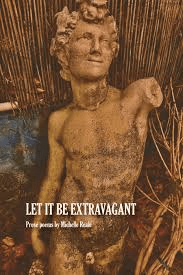
Michelle Reale’s Let It Be Extravagant is a lush, ominous, and deeply fascinating collection of prose poems. As an exercise in sustaining tone, I don’t think I’ve ever encountered a collection, which does it as well. The title points at “extravagance”, and a few poems in, I began to recognize that this extravagance might refer to the enormity of emotions that accompany its speaker’s loping, winding passages. Maybe “let it be extravagant” is not an order so much as it is a meditation: If you are going to live a thing as complicated as a human life, perhaps you need to have the grace to let it play out, in all its chaotic grandeur.
Which is not to say that doing that is easy. On the contrary, much of this collection focuses on how difficult, how menacing, and how traumatic a life can be. Let It Be Extravagant is about pain. It is about processing pain; about the difficulty of processing pain. And it is about how families – mothers, fathers, brothers, sisters, husbands and wives, and sons and daughters – persist in spite of that pain, rely on each other to persevere in the face of it, live on in its shadow because that’s all that can be done.
Reale’s words give a voice to a kind of grief and suffering which feels both personal and universal. Every poem here has at least one moment of clarity, which binds its thesis with some powerful, concrete image. Often, these images are abstract but still very visible and coherent. In one of my favorite pieces – “Auditory” – the speaker converses with her “future son” by pressing her ear at “the mouth of a cleft in a rock”. As she does so, the son “picks his teeth with the splintered bone of his ancestor” whom he’ll be named after. There are six unique entities mentioned in this specific poem – the speaker, son, and “splintered ancestor” among them – and as the images in this poem flit between them, each for a moment plays a part in a surreal, almost mystical chorus. There is a looming sense of foreboding that accompanies this collection, and this feeling is enhanced by Reale’s creativity and willingness to follow her images to their conclusions.
Reale’s decision to use prose poetry as her format also adds to the unique feeling she’s able to cultivate. Nearly every piece here is formatted the same: As a single paragraph, divided into sentences of fairly standard length. While I’m sure slicing these up into different combinations of stanzas would yield some interesting results as well, the fact that this format is so consistent helps the words and images themselves feel more prominent. Each piece reads the same in the sense that one idea flows into and supplements another. There is no awkwardness among the transitions, no jarring of the reader’s sense when one line breaks to the next. Each piece is a sermon of sorts: Self-contained and elegant.
Beyond that, the brilliance of these poems lies in their ability to fuse vastly different images in an almost effortless manner. In “Celestial Opportunities”, for instance, Reale blends the enormity of space – “cosmic”, “supernova”, the death of a star – with the intimacy of birth; its pain, its brilliance, and its miraculousness. And like the rest of this collection, this binding of ideas doesn’t feel forced – on the contrary, Reale’s language highlights the natural connections between seemingly unrelated things. “We come from stars, but we are not the stars,” she writes; and yet, as she concludes correctly, “We will join them when the time is right.” Something I admire about this piece specifically (but also this collection as a whole) is its ability to advance intelligently toward its conclusion. The lines I’ve cited here are interspersed with others that add depth and nuance to the climax, and this complexity is a common thing in this collection.
Let It Be Extravagant, with its cascade of convening and contrasting imagery, is actually quite a complicated text. There is so much here to think about – each page, each passage is so dense and overflowing with ideas and images. The emotion in each piece can be overwhelming, almost contradictory, in a way that manages to capture the unique breadth of the human experience. That, I think, is what gives this collection its character, and what makes it so beautifully impactful.
Reale displays precision and mastery over her poems. There are infinite volumes and missives about the things she writes of, yet her creations feel incredibly fresh. She offers perspectives on so many specific feelings – the coldness of a somber childhood bedroom, a first moment of awareness, the ache of a family dinner which goes the same way it does every time – which are presented more completely and elegantly than I’ve ever seen them put, in rich and intimate passages. The year may have only just begun, but I know this one will go down as one of my books of the year. If you have any interest in the depths, which a human heart can hold, Let It Be Extravagant is a necessary experience; and I can say with certainty that you will find it a fulfilling one.
Bio:
Vincent Sergiacomi is a poet and writer. His poetry has appeared in publications including Poetry Pacific, the Eunoia Review, and the Moonstone Arts Center’s New Voices anthology. His criticism has been featured in Ovunque Siamo and the Philly-based Loco Magazine. Vincent holds a degree in English from Arcadia University. He currently resides with his fiancée and their two cats in West Philadelphia.
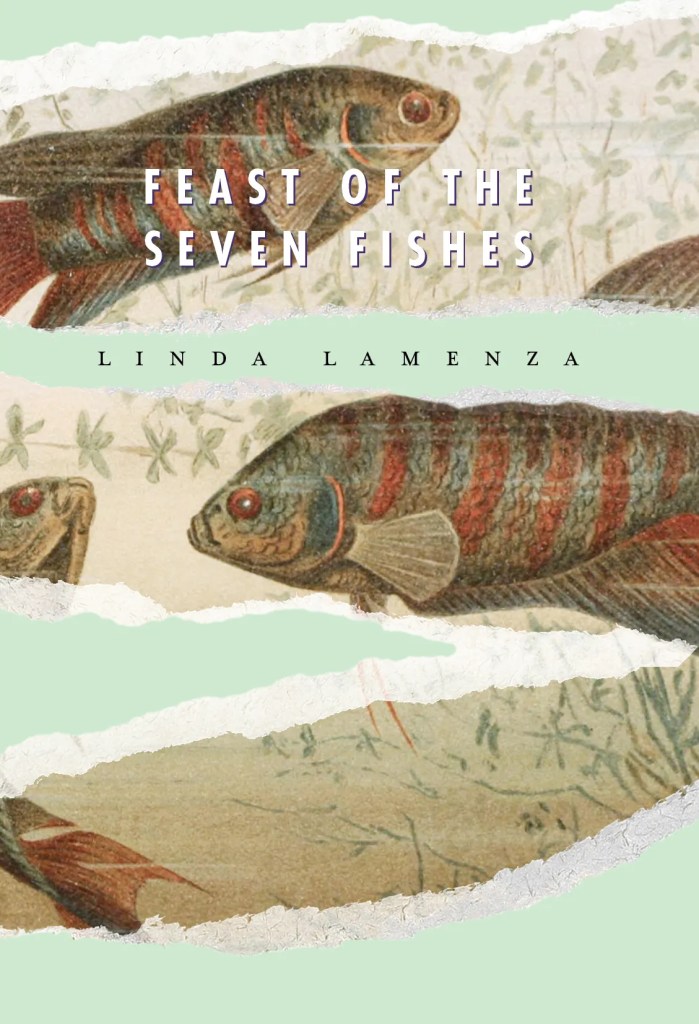
Feast Of The Seven Fishes, Linda Lamenza, Nixes Mate, 2024, 105 pages
Reviewed by Heather Nelson
Although the traditional Italian-American Feast of the Seven Fishes comes at the end of the year, Linda Lamenza’s title poem, “Feast Of The Seven Fishes’ arrives early in her book, folded into her life experiences as a decidedly untraditional Italian-American who nonetheless holds family dear and finds her heritage meaningful. The title poem itself is split in its center, listing the ingredients needed for the feast, and examining them with a critical eye. In the poem, Lamenza is out shopping with her mother’s list of ingredients, but without mother herself. Instead she is traveling with her sister and older brother “in the back of the Pontiac, free of my parents.” How exciting! However, anxiety intrudes on the young Lamenza’s adventure as she wonders if it is OK to use whitefish “a Jewish fish” in a traditional Catholic dish? She is uncertain, the shopkeeper says no. She sympathizes with captive lobsters with their “blue rubber-banded claws” and the awkward reception the “Jewish Fish” will face at her house. Ultimately, she advocates for conformity with culinary tradition, suggesting “whiting” in a whisper to her brother, who places the order.
Difficult choices and conflicting obligations follow the speaker well into adulthood. In “50th Birthday” the poet “perseverate[s]” over opportunities lost, tasks uncompleted. Again the in the grocery store, she is “immobilized” by the lighting and feels an urgent need to escape before she implodes and is injured by “the shrapnel of childhood/that pressure cooker.” However, that same childhood holds beautiful experiences which shape the poet as much as the stress does. The poem “In The Garden of My Childhood”, portrays a poet who embraces the foods she grew up with-their colors, flavors and seasons- with unambivalent relish. The poem is lean and orderly, like a garden row, with elegant twists: “A tangle of /cucumber tendrils entwines/the trellis.” This garden’s growth is allusive and musical, a “river rock path winds through Roma/tomatoes.” Lamenza witnesses the passage of time here with care and precision, inverting the relationship between cultivator and cultivated: “Basil harvests pre-autumn/sky.” The reader’s appetite is whetted for the flavors to be garnered from this garden, “rife/ with expectation.”
The book’s first section, “Colazione” (breakfast), opens with a glimpse into the past, “Grey Advertising 1956”, is a wry and innovative poem in which the type-writer speaks, giving what others see as a fixture a voice of its own. “I am merely a machine” it notes, but proceeds to produce insights about its own work that may elude the office staff. The work is all urgent “DUE DATE underscored” and constant “too-fast typing” over “weary/work hours” but boring too, “Nearly fell asleep on/the 12th one,” The machine longs for the end of the day, noting “Stillness is my balm.” The poem left this reader wondering what other household “fixtures” might be exhausted and overlooked, working from breakfast to dinner, calcione to cena, without much choice or variation.
Such a dutiful, but possibly resentful, domestic worker is found near the end of the book in the poem “Cleaning Out The Sock Drawer.” The speaker of the poem is driven to the task a bit grudgingly, “Because it’s overstuffed” and “because I cannot find two socks that match.” She feels compelled to empty the drawer and sort out everyone’s socks, to deal with the frustrating minutiae of the household, deciding which socks to “ditch or patch.” “Halfway through this task” the sorting process leaves the speaker “overwrought” and “overwhelmed.” Obviously the task isn’t difficult so much as “fraught”, driven by oughts which manifest as “sock puppets” in her dreams, chiding her and driving the speaker to abandon the task she never really chose, to “runaway, rebel/it seems.”
The book closes with a glimpse of what a rebellious Italian-American life might look like if the poet chooses not to run away, but rather to come as she is. In “ St. Mary Of Carmen Society Annual Italian-American Festival”, an iconic woman, “La Madonna del Carmine”, is displayed and celebrated. Also present at the festival are women whose hands are “brushing gently, as if on a first date.” These are authentic Italian-American women, caretakers of a disdainful daughter and happy consumers of fried dough. Lamenza’s book, like the “one-toothed clerk” deftly hands us our change, the ability to be our eloquent and distinctive selves, inhabiting a world full of colorful and contradictory traditions, with honesty and humor.
 OVUNQUE SIAMO