

At the Hour of Now, by Maria Lisella. Bordighera Press, 2026, 102pp. $17
Reviewed by Vincent Sergiacomo
Your staggering belief mystifies me: that you
will see me over and over again, guide me
to the next rung of love, life, and the first
spring without you.
— “Anniversary”, Maria Lisella
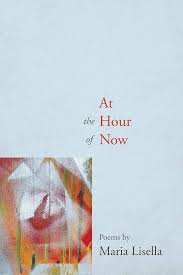
At the Hour of Now is some of the best poetry I have read in a long time. Its poems are saturated with emotion and are consistently, shatteringly gorgeous. It is powerful, evocative in ways which only the best poets manage to achieve. And its subject matter is painful yet universal: To summarize it as a story of love, loss and grief does not nearly do it justice, as its poet’s unique voice and insight foster longing, heartache, and epiphany in equal measure.
Maria Lisella’s At the Hour of Now is not just her words. The collection contains poems from Lisella’s late husband, Gil Fagiani, and her stepson, Mario Fagiani. That gives Lisella a very unique role: She is not just purveyor of her own thoughts, but also the curator of her family’s voices.
She excels in both roles. We get a chorus of three intersecting lifetimes here, of three people experiencing the same moments from different angles. Each voice has its purpose: Lisella becomes our de facto narrator, her words prying and examining, the poet running her fingers over each moment. Gil’s voice adds exposition, his words often lively and intense, almost like a newscaster’s narration. And Mario’s voice is the most creative, evocative and experimental, at once poised and passionate. Each subject is observer one moment, observed the next, and the collection’s arrangement does excellent work setting them in cohesive scenes. This is masterful interplay. It is difficult to find a collection as beautifully unique as At the Hour of Now, where so often we are reading one person’s context and perspective against, within, and alongside another’s.
Lisella’s voice is the most frequent and prominent here, and the strength of her words propels the collection. On a technical level, Lisella paces her poems with a deft emotional rhythm. Every phrase moves with intent: In the opening poem, “What I’d Wish For You,” each line and idea transitions effortlessly into the next (“but it isn’t you, can’t be/you now that you are living in a space/of darkness and delusion”). The next, “Bronx Boom Boxes,” levies a fiery sound as it explores sound: The poem’s form and its impact are powerful and gut-wrenching, as is its conclusion. This cadence continues throughout, Lisella’s power as a poet bringing an extra charge to moments already fraught with emotion.
The collection’s emotional progression is bolstered by Lisella’s unwavering awareness of form. Again, she
curates with vision and passion: Each poem’s title carries weight, acting with its own volition, framing its respective body purposefully and with elegance. It is telling too that while all of Lisella’s poems maintain a vaguely similar multisyllabic free verse, there is no hard and fast rule to her construction across the volume. This set of poems is tumultuous, evolving, never at rest, and so is its structure, both as a collection and as an array of distinct pieces. And the asymmetry of the collection’s third and final part compared to its first two is no accident. Every minute decision here feels like it was weighed, each outcome considered, leaving a brutal form eroded out of this battering storm of ideas.
“Brutal” is not an understatement here. At the Hour of Now is a deeply personal, intensely moving book. As a result, it can be difficult to get through, at least without stepping aside for a while. I liken the experience to listening to a song attached to your most poignant memory: It is compellingly, forcefully emotional. As with most challenging things, this difficulty is a symptom of its importance. Lisella is not telling easy stories, but she is telling important ones. As all great poets do, she has tapped into the root of what makes us human, and her skill in displaying this truth to her readers is monumental. Essential reading to be sure, and certainly one of the most excellent collections of the decade.
Vincent Sergiacomi is a poet and writer. His poetry has appeared in publications including Poetry Pacific, the Eunoia Review, and the Moonstone Arts Center’s New Voices anthology. His criticism has been featured in Ovunque Siamo and the Philly-based Loco Magazine. Vincent holds a degree in English from Arcadia University, and currently resides with his fiancee and their two cats in West Philadelphia.

