

Swerving Size by Michael Cocchiarale. Unsolicited Press, 2026, 150 pp. $18
Reviewed by Vincent Sergiacomi
What is a life if not the sum of its moments? Take your own, maybe, and pull a day out of it. Better yet, a few hours, a few minutes; maybe just a painfully long second. Stand the excerpt on its own and it still means something. Stack a few side by side and suddenly you’ve built a person.
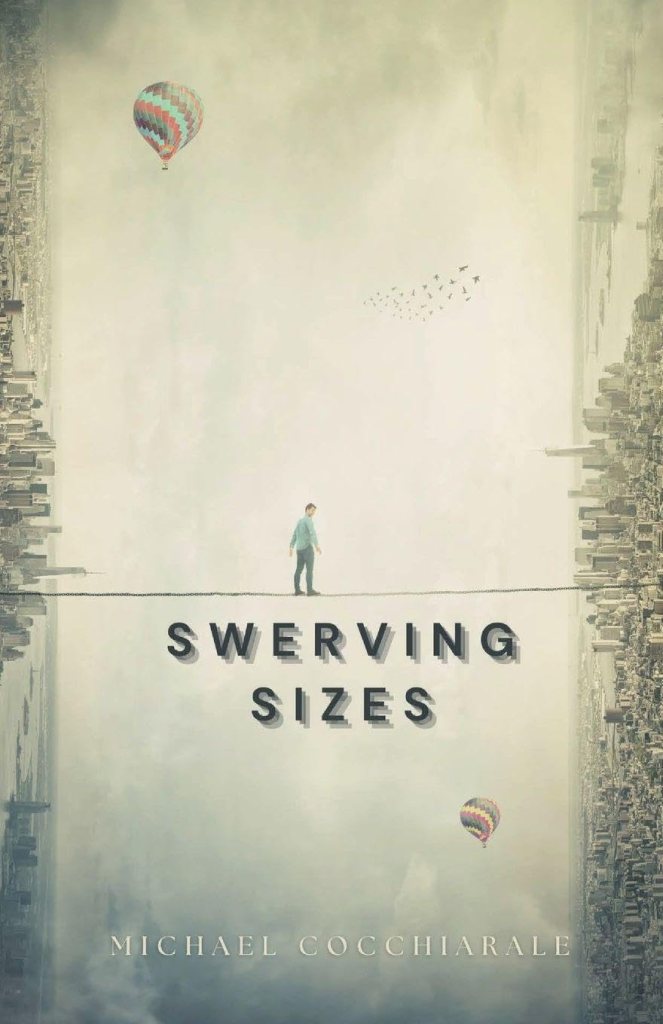
Michael Cocchiarale’s Swerving Sizes is an exercise in this disassemblage of life, asking what we can glean of a person from a few tersely narrated moments. It is magnificent in many ways. As a collection of microfictions, it would be impossible to overlook the impact of its format on the end result, but there’s so much more here that I think is worth mentioning. True, these side-by-side stories accumulate into a crescendo of feeling by the volume’s conclusion, but picking one out on its own will do the same. Its author’s prose is discerning, fierce, and evocative, with a deft awareness of sound and feeling.
If Cocchiarale is stacking lives and building people in print, his subjects are wobbly and misshapen. Some have names, some are just ideas (one of my favorites is “Second Father,” who “gobbled sausage like First glugged gin”), but all are fascinating. A sense of foreboding is constant. Cocchiarale has a talent for saying enough to make his point, while leaving enough details obscured to hint at something deeper, darker. Angst is apparent in most of these characters; perhaps the tie that binds is their collective despair, or maybe I’ve simply read that into the empty space which Cocchiarale has so expertly constructed.
That empty space – more of an intentional void than an absence – shines brightest in the more dialogue-heavy narratives. In “Game Changer,” for instance, the conversation between our characters feels very casual, even if its subjects – baptism, cancer, life’s beginning and its potential end – are objectively heavy. There is relatively little exposition, yet the scene is vivid, and the people feel like people. In a longer work, where there is time to build characters across chapters, this might be taken for granted. But here it is not only impressive how quickly Cocchiarale is able to introduce us to his subjects, but how elegantly he does so.
“Game Changer” ends with a flourish of prose that shifts the entire feeling of the piece. It fuses poetically intuitive sound with a powerful narrative voice: “Steve sighs, shrinks, seeks refuge in where they all began: those grade school days, that runner-up year […] hands in a circle before the whistle was blown.” It is an almost perfect unity of emotion and form, so impressive yet somehow consistently performed across this collection. The lack of context, key life events taking the form of vague hints and offhand mentions, almost makes these moments more evocative. Out of a formless mist we can identify the vague outlines of a life – it’s almost a challenge to identify what we can know versus what we can assume, and what we can only guess at.
As a reader, working from a context deficit inspires a different kind of discernment: You find yourself reading the text against itself at times, and against your own intuition at others. Scarcity increases value, and so every word is worth its weight in gold. Sure, you can speed through with ease if you try, but taking these pieces slowly, meditating on their form and their structure, is such a powerful experience. Why, in “First Clear Morning of a Week at St. Ives,” do the waves move “like promises made then unremembered”? When the narrator of “Last Dance” describes a “whip-smart world,” is that his world, or the world of his father whom it’s set to crush? In “Meme and Response,” who’s asking all these questions? Maybe our author himself has an idea, but as a reader you’ll never know – and there’s something beautiful about that in a world where every scrap of information can be summoned in a few seconds without any effort at all.
Reading Swerving Sizes will make you realize what a damn shame it is that microfiction is not more prevalent, especially microfiction that’s this well written. It is at once an exercise in feeling that can’t really be replicated in any other form, a dreamlike meander into a library of unfinished books, and a paradoxically complete assessment of the range of the human experience. Michael Cocchiarale has created something poignant, visceral, and always thoughtful. Do yourself a favor and make these stories a part of your own.
~~~~
Vincent Sergiacomi is a poet and writer. His poetry has appeared in publications including Poetry Pacific, the Eunoia Review, and the Moonstone Arts Center’s New Voices anthology. His criticism has been featured in Ovunque Siamo and the Philly-based Loco Magazine. Vincent holds a degree in English from Arcadia University, and currently resides with his fiancee and their two cats in West Philadelphia.

